About
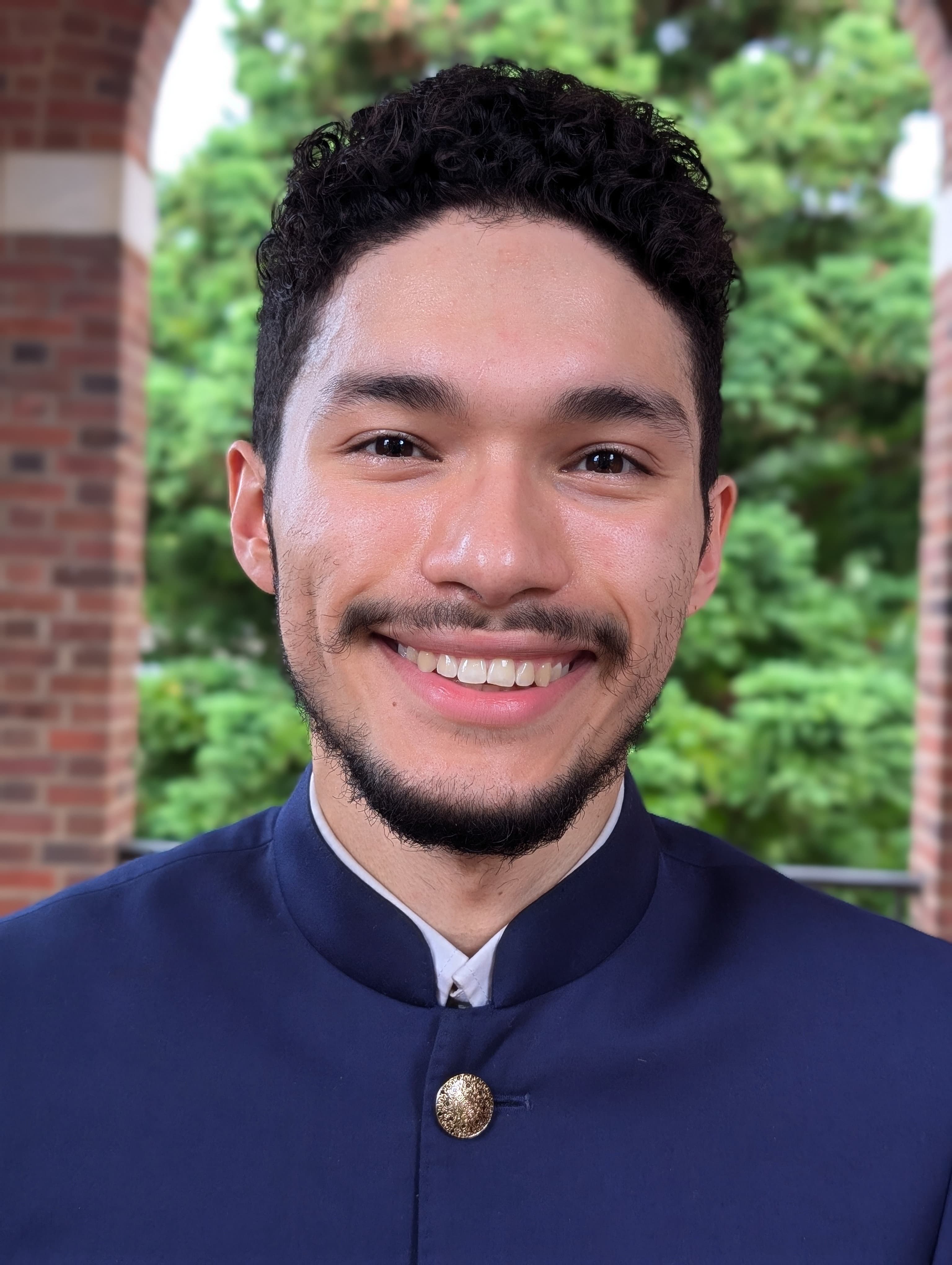
Alejandro J. Soto Franco
Alejandro José Soto Franco
Maths · Rust · CUDA · Quant
Holonomy SecuritiesI trained as a biomedical engineer at Johns Hopkins, where research on active matter pulled me into differential geometry and PDE theory, and into a PNAS paper on topological defects that braid themselves into periodic orbits. That love for complex systems shaped by their geometry and topology shapes everything I build. I now lead Holonomy Securities, a three-person systematic trading firm, maintain open-source Rust libraries for geometric computing and stochastic analysis, and formalise analysis in Lean. Away from the desk I cook, DJ, lift, mod Supreme Commander: Forged Alliance, and play Risk of Rain 2.
Resume
Experience
| Jun 2026 – present | Ishaya and Associates HPC and ML Associate Remote | Model development and the high-performance computing beneath it for reservoir and petrophysics engagements. Gaussian-process regression, kriging with conditional simulation, and conformal prediction for calibrated P10 to P90 uncertainty, with GPU pipelines in Rust (Burn) and Python, plus a 3D Darcy-flow reservoir model. Designed the leave-one-well-out cross-validation that exposed data leakage in naive splits. |
| Jun 2026 – present | LOT, Ingeniería y Tecnología Petrolera Consulting CFD Engineer Remote, Saltillo, Mexico | The computational fluid dynamics campaign for a patent-stage pump: boundary conditions, CAD geometry refinement, and compressible high-speed multiphase flow tuned for gas-liquid mixing against inlet backpressure. OpenFOAM with bespoke Rust CFD tooling, geometry in a Rust CAD kernel, meshing through Gmsh. Under NDA. |
| Dec 2025 – present | Founding Principal Remote | Co-founded a systematic trading firm, three people, building quantitative engines across prediction markets and equity options on a shared Rust substrate. Built Colosseum, a multi-asset backtesting and execution platform with a WASM strategy sandbox, CLOB-native market data, configurable fill models and a full audit trail, and Polybius, a Polymarket-native binary-options system with non-stationary SDE regime models. Architecture, GPU and async systems, risk modelling, and production operations on AWS. |
| Aug 2025 – Oct 2025 | Anti Capital Rust Trading Strategies Developer New York, NY | Spot automated market-making strategies for crypto tokens on a Rust trading engine. Shipped a pre-debit balance guard that eliminated insufficient-balance order rejections across a multi-exchange execution stack. Tokio, WebSockets, and a lock-free actor model where each actor owns its state and communicates over channels. |
| Dec 2023 – May 2025 | Johns Hopkins University, Physics and Astronomy Research Assistant, Beller group Baltimore, MD | Active-matter physics in confined two-dimensional active nematics. Second author on the PNAS paper showing that +1/2 topological defects lock into periodic orbits whose periodicity follows the metallic ratios, with chaotic mixing read through the Burau representation of braid groups. Built the braid-classification pipeline, Python first and later ported to Rust. |
| Jan 2022 – Feb 2024 | Johns Hopkins University, Institute for NanoBioTechnology Research Assistant, Mao-Schneck laboratory Baltimore, MD | Polymeric nanoparticles for solid-tumour immunotherapy. Synthesised roughly 83.6 nm PEG-b-PLGA micelles carrying recombinant interleukin-2 and dextran-sulfate polyelectrolyte complexes, characterised size and zeta potential, and demonstrated tunable sustained release to two weeks in an analogue albumin model. |
Ishaya and Associates
HPC and ML Associate
Model development and the high-performance computing beneath it for reservoir and petrophysics engagements. Gaussian-process regression, kriging with conditional simulation, and conformal prediction for calibrated P10 to P90 uncertainty, with GPU pipelines in Rust (Burn) and Python, plus a 3D Darcy-flow reservoir model. Designed the leave-one-well-out cross-validation that exposed data leakage in naive splits.
Jun 2026 – present · Remote
LOT, Ingeniería y Tecnología Petrolera
Consulting CFD Engineer
The computational fluid dynamics campaign for a patent-stage pump: boundary conditions, CAD geometry refinement, and compressible high-speed multiphase flow tuned for gas-liquid mixing against inlet backpressure. OpenFOAM with bespoke Rust CFD tooling, geometry in a Rust CAD kernel, meshing through Gmsh. Under NDA.
Jun 2026 – present · Remote, Saltillo, Mexico
Founding Principal
Co-founded a systematic trading firm, three people, building quantitative engines across prediction markets and equity options on a shared Rust substrate. Built Colosseum, a multi-asset backtesting and execution platform with a WASM strategy sandbox, CLOB-native market data, configurable fill models and a full audit trail, and Polybius, a Polymarket-native binary-options system with non-stationary SDE regime models. Architecture, GPU and async systems, risk modelling, and production operations on AWS.
Dec 2025 – present · Remote
Anti Capital
Rust Trading Strategies Developer
Spot automated market-making strategies for crypto tokens on a Rust trading engine. Shipped a pre-debit balance guard that eliminated insufficient-balance order rejections across a multi-exchange execution stack. Tokio, WebSockets, and a lock-free actor model where each actor owns its state and communicates over channels.
Aug 2025 – Oct 2025 · New York, NY
Johns Hopkins University, Physics and Astronomy
Research Assistant, Beller group
Active-matter physics in confined two-dimensional active nematics. Second author on the PNAS paper showing that +1/2 topological defects lock into periodic orbits whose periodicity follows the metallic ratios, with chaotic mixing read through the Burau representation of braid groups. Built the braid-classification pipeline, Python first and later ported to Rust.
Dec 2023 – May 2025 · Baltimore, MD
Johns Hopkins University, Institute for NanoBioTechnology
Research Assistant, Mao-Schneck laboratory
Polymeric nanoparticles for solid-tumour immunotherapy. Synthesised roughly 83.6 nm PEG-b-PLGA micelles carrying recombinant interleukin-2 and dextran-sulfate polyelectrolyte complexes, characterised size and zeta potential, and demonstrated tunable sustained release to two weeks in an analogue albumin model.
Jan 2022 – Feb 2024 · Baltimore, MD
Education
| Aug 2024 – May 2025 | M.S. Biomedical Engineering Johns Hopkins University | Admitted through Combined Graduate Study. With no course-specific requirement, the schedule ran toward advanced mathematics and theoretical physics: differential geometry, calculus on manifolds, condensed-matter and statistical physics, nonlinear dynamics, computational modelling of soft and biological materials, and the mathematical foundations of data science. |
| Aug 2021 – May 2025 | B.S. Biomedical Engineering Johns Hopkins University | Graduated with General Honors and Departmental Honors in Biomedical Engineering, cumulative GPA 3.58 across 154.5 credits against a 129.0 requirement, carrying two multi-year research appointments in parallel. Kam Leong Research Fellowship · John and Marion Kreutzberg Scholar · Dean’s List |
M.S. Biomedical Engineering
Johns Hopkins University
Admitted through Combined Graduate Study. With no course-specific requirement, the schedule ran toward advanced mathematics and theoretical physics: differential geometry, calculus on manifolds, condensed-matter and statistical physics, nonlinear dynamics, computational modelling of soft and biological materials, and the mathematical foundations of data science.Aug 2024 – May 2025
B.S. Biomedical Engineering
Johns Hopkins University
Graduated with General Honors and Departmental Honors in Biomedical Engineering, cumulative GPA 3.58 across 154.5 credits against a 129.0 requirement, carrying two multi-year research appointments in parallel.Kam Leong Research Fellowship · John and Marion Kreutzberg Scholar · Dean’s List
Aug 2021 – May 2025
Publications
| PNAS 123, e2516670123 (2026) | Chaos-generating periodic orbits of topological defects in confined active nematics Klein, Soto Franco, et al. Second author. | |
| Preprint, Zenodo (2026) | Configuration-space curvature and the Navier-Stokes singular set Sole author. Identifies the curvature of the L² metric on SDiff(T³) with the pressure Hessian. | |
| Zenodo (2026) | Surgery in membrane fusion Sole author. The Gaussian-curvature term of the Helfrich energy is the only one a topology change moves, and what it counts along a fusion pathway is a surgery number. | |
| Preprint, in preparation | ermak: GPU-accelerated Brownian dynamics for ligand diffusion and dissociation kinetics Sole author. Ermak-McCammon propagator on the GPU, roughly 43× the CPU reference in the f32 path. | |
- Chaos-generating periodic orbits of topological defects in confined active nematics
Klein, Soto Franco, et al. Second author.
PNAS 123, e2516670123 (2026)
- Configuration-space curvature and the Navier-Stokes singular set
Sole author. Identifies the curvature of the L² metric on SDiff(T³) with the pressure Hessian.
Preprint, Zenodo (2026)
- Surgery in membrane fusion
Sole author. The Gaussian-curvature term of the Helfrich energy is the only one a topology change moves, and what it counts along a fusion pathway is a surgery number.
Zenodo (2026)
- ermak: GPU-accelerated Brownian dynamics for ligand diffusion and dissociation kinetics
Sole author. Ermak-McCammon propagator on the GPU, roughly 43× the CPU reference in the f32 path.
Preprint, in preparation
Formalisation
| Mathlib4 | Closure lemmas showing that functions with compact multiplicative support form a submonoid, with follow-on results for List, Multiset and Finset products. | |
| infinity-cosmos | Six pull requests merged into Emily Riehl’s ∞-cosmos library, covering library results, toolchain moves and CI. | |
| EllipticPDE | Existence and uniqueness for second-order divergence-form elliptic operators through Lax-Milgram, the Gårding inequality, the complete Fredholm alternative, and interior regularity at every order. No sorry in the library, asserted in CI. | |
Closure lemmas showing that functions with compact multiplicative support form a submonoid, with follow-on results for List, Multiset and Finset products.
Six pull requests merged into Emily Riehl’s ∞-cosmos library, covering library results, toolchain moves and CI.
Existence and uniqueness for second-order divergence-form elliptic operators through Lax-Milgram, the Gårding inequality, the complete Fredholm alternative, and interior regularity at every order. No
sorryin the library, asserted in CI.
Skills
| GPU and HPC | CUDA (cudarc, cuFFT), Vulkan (ash, VkFFT), wgpu, PTX codegen, cross-backend FFT, zero-copy interop, SLURM | |
| Rust | Tokio, async, rayon, serde, ndarray, sqlx, duckdb-rs, PyO3 and maturin | |
| Lean 4 and Mathlib | Elaboration, metaprogramming, tactics, linters, DiscrTree, environment walking | |
| Mathematics | Differential geometry, geometric measure theory, stochastic processes, functional analysis, PDEs, active-matter physics | |
| Machine learning | Transformer fine-tuning (PEFT/LoRA), contrastive learning, knowledge distillation, FlashAttention 2, hard-negative mining | |
| Other | Python, C++, Fortran, Julia, Fedora and Linux, LaTeX | |
GPU and HPC
CUDA (cudarc, cuFFT), Vulkan (ash, VkFFT), wgpu, PTX codegen, cross-backend FFT, zero-copy interop, SLURM
Rust
Tokio, async, rayon, serde, ndarray, sqlx, duckdb-rs, PyO3 and maturin
Lean 4 and Mathlib
Elaboration, metaprogramming, tactics, linters, DiscrTree, environment walking
Mathematics
Differential geometry, geometric measure theory, stochastic processes, functional analysis, PDEs, active-matter physics
Machine learning
Transformer fine-tuning (PEFT/LoRA), contrastive learning, knowledge distillation, FlashAttention 2, hard-negative mining
Other
Python, C++, Fortran, Julia, Fedora and Linux, LaTeX
Languages
| Native | Spanish, English | |
| Limited working | Mandarin Chinese | |
| Reading | Portuguese, Italian, French, Arabic | |
Native
Spanish, English
Limited working
Mandarin Chinese
Reading
Portuguese, Italian, French, Arabic